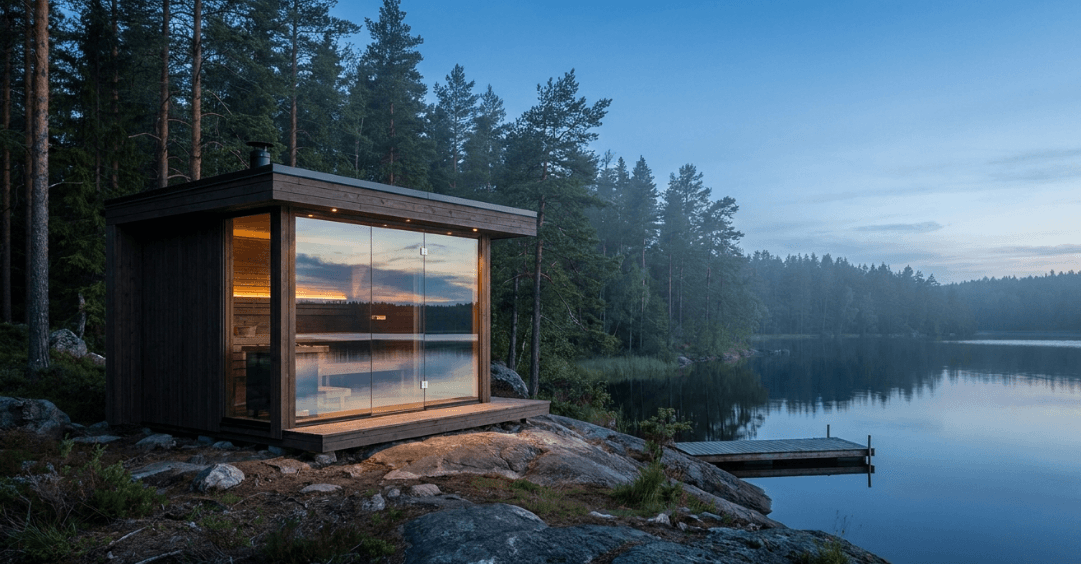
Traditional saunas heat the air around you, using an electric or wood-fired stove and stones, and typically run 150 to 190 degrees Fahrenheit with the option of steam. Infrared saunas use panels that warm the body and surfaces more directly at a lower air temperature, usually 120 to 140 degrees Fahrenheit, plug into standard household power, and take up slightly less structural bulk for the same seating capacity. For a small yard, infrared generally wins on ease of installation and lower running cost, while traditional wins on the classic high-heat, steam-capable experience most people picture when they think “sauna.”
What’s the Basic Difference Between the Two Heat Types?
A traditional sauna heats the air in an enclosed space using an electric stove or a wood-fired stove topped with stones, and that hot air in turn warms your body by convection and radiant heat off the stones. Adding water to the stones creates steam, or löyly, which is part of what many people associate with a traditional session. An infrared sauna instead uses carbon or ceramic panels mounted on the walls that emit infrared wavelengths absorbed more directly by skin and tissue, warming the body at a lower ambient air temperature rather than heating the whole room first. There is no steam option with infrared, since there is no stove or stones to add water to.
Which One Fits a Small Footprint More Easily?
Both formats come in compact two to three person builds that fit a small patio or side yard, so footprint alone rarely decides this comparison. Where infrared has a practical edge is in overall bulk and clearance requirements, since the panels themselves are thin and mount flush to the interior walls, and infrared units generally need less clearance to fences and combustible surfaces than a traditional stove does. That can matter on a genuinely tight lot where a few extra inches of buildable space against a property line changes what fits at all.
Which Costs Less to Buy and Run?
Compact infrared cabins for two to three people are often priced somewhat lower than equivalent traditional units, and running costs follow a similar pattern, since infrared panels typically draw less power per session than a traditional electric stove holding a much higher air temperature for the same period. A traditional wood-fired stove sidesteps electricity costs entirely but adds the ongoing cost and effort of sourcing dry, seasoned wood. Shoppers comparing current prices across both heater types for a small-capacity build can view current pricing from specialty outdoor sauna retailers to see how the gap actually plays out on finished units rather than spec sheets alone.
Which Needs Less Electrical Work?
This is usually the deciding factor for buyers on a tight timeline or budget for site work. Traditional electric stoves in the 6 to 9 kilowatt range typically need a dedicated 240-volt circuit, often 30 to 50 amps, which usually means hiring an electrician and possibly pulling a permit. Infrared cabins commonly run on a standard 120-volt, 15 to 20 amp circuit, close to what a space heater draws, and some can work off an existing outdoor-rated outlet without any new circuit at all. Wood-fired traditional stoves skip electrical work entirely but require a code-compliant chimney and clearance instead.
How Long Does Each Type Take to Warm Up?
A traditional stove needs roughly 30 to 45 minutes to bring a small cabin up to full temperature, since it has to heat both the air and a bed of stones before the space feels ready for a session, and that warm-up time is part of why many traditional sauna owners plan a session in advance rather than deciding on the spot. Infrared cabins typically reach a usable temperature in 10 to 15 minutes, since the panels warm the body directly rather than heating the whole volume of air first, which makes an infrared unit a more realistic option for someone who wants a shorter, spontaneous session after work or a workout rather than planning around a longer lead time.
What About Everyday Convenience and Noise?
Traditional stoves run largely silent apart from the occasional hiss when water hits the stones, which many owners consider part of the experience. Infrared panels are also quiet, though some models use a small fan to help distribute heat evenly, which adds a faint background hum some owners notice and others do not. Day-to-day upkeep favors infrared slightly, since there is no ash, no wood storage, and no chimney to inspect, while a wood-fired traditional stove asks for more regular attention in exchange for the higher, steam-capable heat it delivers.
Which Has the Stronger Health Research Behind It?
Almost all of the long-term population research on sauna bathing and cardiovascular health comes from traditional Finnish-style sauna use, not infrared. A review covering the physiology of heat and cold exposure, including traditional Finnish sauna bathing specifically, described cardiovascular and other associations tied to regular use of that format. A systematic review of clinical studies on regular dry sauna bathing reported similar associations across cardiovascular and respiratory outcomes in the trials it summarized, and a 2023 review in Mayo Clinic Proceedings extended that picture by looking at sauna bathing alongside other lifestyle factors like physical activity. Infrared sauna use has a much smaller and more recent research base by comparison, which is not evidence against it, simply evidence that has not accumulated the same decades of long-term cohort data traditional sauna bathing has.
So Which One Actually Suits a Small Yard?
If the priority is minimizing electrical work, upfront cost, and clearance requirements, infrared is the more practical choice for most small lots. If the priority is the classic high-heat, steam-capable experience and there is budget for a dedicated circuit, a compact traditional cabin or barrel still fits plenty of small yards without much compromise. Neither choice is objectively better; they suit different priorities around installation complexity, running cost, and the kind of heat someone actually wants to sit in.
Frequently Asked Questions
Can you sit in a traditional sauna and an infrared cabin for the same length of time? Not usually. Traditional sessions run 10 to 20 minutes because of the higher temperature, while infrared sessions often last 20 to 30 minutes at a lower temperature.
Does either sauna type work well in a cold winter climate? Both work outdoors in cold climates. A traditional stove holds a higher temperature more easily against cold air, while infrared cabins may take longer to feel warm on very cold days.
Can you add steam to an infrared sauna? No. Infrared panels heat the body directly rather than heating air with water added to stones, so there is no steam option in an infrared cabin.
Which sauna type is easier to resell or move later? Both hold resale value reasonably well if maintained, though infrared cabins are generally lighter and simpler to relocate since they skip the dedicated high-voltage circuit.
References
- Effects of heat and cold on health, with special reference to Finnish sauna bathing, American Journal of Physiology – Regulatory, Integrative and Comparative Physiology, 2018
- Clinical Effects of Regular Dry Sauna Bathing: A Systematic Review, Evidence-Based Complementary and Alternative Medicine, 2018
- Does the Combination of Finnish Sauna Bathing and Other Lifestyle Factors Confer Additional Health Benefits? A Review of the Evidence, Mayo Clinic Proceedings, 2023